
Martha Gellhorn & Ernest Hemingway

Martha Gellhorn & Ernest Hemingway - the enemy in her bed<o:
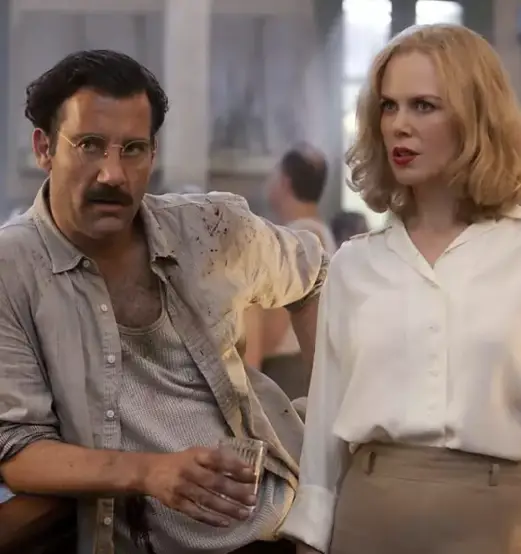
photos HBO
Martha Gellhorn was the first woman – war correspondent to travel the world to cover wars. She lost only one war – the one with Hemingway in their family bedroom.
“Why do people talk about the horror of the later years? I feel like a nice old car with parts going out of commission bit by bit, but I don’t complain… Only those who haven’t achieved what they want in life are frightened of old age.” At 90, half blind, with advanced ovarian and liver cancer, Martha Gellhorn decides her own path again. She reaches for the nightstand, overdoses on her medication, and leaves the war of this life. Perhaps also out of curiosity to see what’s beyond.
The calm of war
Although she doesn’t like to comment on it, Martha Gellhorn was Ernest Hemingway’s third wife and the only one who left him. Among the men in her life was Lawrence Rockefeller, a billionaire philanthropist like his own grandfather John.
Herbert Wells was very much in love with her and pursued her for a long time, and she, preserving their friendship, commented, “Why should I sleep with a short old man when I can have any tall and handsome young man!” And so it is. She has relationships with many eminent and nameless ones. Martha is left-leaning, a leftist, an atheist, a writer, a glamorous socialite, the first female war correspondent, and the journalist who covered the most wars in the 20th century – the civil wars in Spain, El Salvador and Nicaragua, World War II, the Vietnam War, and the Arab-Israeli conflict. She has traveled to 50 countries and lived in 19. One of America’s most prestigious journalism awards was established in her name. “Thanks to journalism,” says Gellhorn, “I had the chance to learn about life in my time. And the life of my time was war. In it I found the peace and order I had always aspired to. I liked not having property, not having problems, even not knowing if I would be alive the next day.”
Paris, the Marquis and Love
As a child, Martha realizes that their home is the only one where dark-skinned people come to dinner. This is unacceptable in the state of Missouri, where she was born, but her parents have liberal views. Her mother – in Gellhorn’s words – is lovely but strange. She fights for women’s rights and maintains that women should suffer for the good of humanity. Her father, an obstetrician-gynecologist, helps them to the contrary. For Gellhorn, who has wanted to become a journalist since she was a child, it is important that women have equal rights with men. And because patience isn’t one of her strongest traits, she left college before she graduated to take a job at The New Republic newspaper. Her first articles appeared there. At 22, determined to become a foreign correspondent, she left for Paris with $72 in her pocket and her typewriter. And there, in addition to writing for Vogue, she met her first love, Bertrand de Jouvenel, a journalist, political scientist and marquis. Highly educated, sophisticated, charming and married, he had lost his virginity 10 years earlier to his stepmother, the French writer Colette. Bertrand is 26, and the love and attraction between him and Gellhorn is passionate. The two behave as if married, although Jouvenel’s wife does not give him a divorce. The love affair thaws over three years, passing through fake orgasms and two abortions, and ends with Martha meeting Colette herself. “What impressed me about her,” she says, “was the way she wrote a book – with such a hard and dull insistence, it was as if she was doing calculations.”
Gellhorn is also writing a novel about a young American woman reporter who has an affair and loses her illusions.
Lynch
The book caught the attention of Harry Hopkins of the Roosevelt administration. Hopkins assembles young reporters to cover the lives of ordinary Americans. Martha is recruited and moves back to America. She writes a fictional story about lynching. Praised by her mother’s friend from school, Eleanor Roosevelt, she naively and timidly admits that she added a little, but apparently “I’m very realistic in my writing because everyone assumed I had witnessed a lynching and I just made it up.” To top it off, she encourages workers in North Carolina to break the windows of the factory where they work to protest working conditions. That’s cause to fire her.
Like a heroin of his books
“Do you want me?” asks Martha, as Hemingway predatorily embraces her one night, presses her face to the wall and pulls down her underwear. Dust pours over their naked bodies from the bombs falling outside the hotel. Two blocks away, the Spanish Civil War is being fought. “I need you!” whispers Ernest excitedly in her ear. The truth is, he wants her, from the moment he sees her at his bar, Sloppy Joe’s in Key West. The year is 1936. The moment Martha, 28, walks into the Sloppy Joe, the 37-year-old Hemingway fixes her from under his round-rimmed glasses, appreciates her smart look and Parisian chic, and nibbles on the giant marlin hanging from the ceiling that he caught illegally. His sweatpants, with traces of blood, protrude from his unbuttoned shirt and outline his tripe. Ernest feels desire for this brazenly beautiful woman with shining hair the color of burnt rye and sinfully long legs (as he would later describe her in his novel For Whom the Bell Tolls under the name Maria). They exchange a few lines. “I know exactly when I fell in love with him,” Martha admits, “When I fell in love with his words.” Perhaps they both sense that something is about to happen between them.
One of the strangest things about Hemingway’s life is the sense that many of the people in his life seem to have stepped out of the pages of his own books. Martha did it consciously. She likes his talent and models herself after the image of his characters, but unfortunately not after the women he liked.
Don’t lock me up! I love you
Ernest tells her he’s going to make a movie about the Spanish Civil War and they arrange to meet in Madrid. In 1937, Hemingway met Martha there, surrounded by his entourage of adoring journalists and prostitutes, saying, “I knew you’d come, daughter, and I arranged for you to make it here.” He booked two rooms in the quiet Florida Hotel, away from the thunder and grenades. And he not only offered one to Martha, but locked her in there the first night. Because, he explains to her, he didn’t want her to be mistaken for a “resistance whore.” Gellhorn is furious. “At that moment, I had to find out the fate of our relationship.” Their passionate romance unfolds against the backdrop of war in Spain, the Soviet-Finnish conflict, the Japanese occupation of China, and World War II. The two were direct witnesses and sometimes participants in these events. They celebrate their first Christmas in Barcelona. Then they went to Cuba, which Ernest had discovered in the early 1930s. Martha finds an abandoned plantation house 15 km from Havana overlooking the sea and the capital, and Hemingway buys it and inhabits it with his favourite hunting trophies from Africa and his countless books.
For whom the bell tolls
Their first year in “Finka Vihya”, as they call the house, is full of love. Hemingway teaches Martha to ride, to shoot, to fish. In the evenings they play tennis. And they work, a lot of work. Martha is impressed by how disciplined he is about his writing. That’s where the bestseller about the Spanish Civil War, For Whom the Bell Tolls, was born. Martha prepares a novel about refugees in Prague. In 1939, after Ernest obtained a divorce from his second wife, Pauline Pfeiffer, he married his great passion, Martha. Passion?
According to Gellhorn, Hemingway was “a terrible lover – ‘boom-bam’, merci, mummy, and end, maybe just ‘boom-bam’. According to Hemingway, Gellhorn was not cut out for bed. In fact, she herself admits, “I was the worst sexual partner on five continents. Even my most experienced partners failed to bring me to orgasm. I got pleasure from their tenderness (often insufficient) after they were satisfied.”
But Gellhorn wasn’t having it and went to England to cover World War II while Hemingway played catch with German U-boats in the Caribbean. He wrote her an angry letter, “What are you, Gellhorn? A war correspondent or a woman in my bed?” Then, devastated by her absence, he greets her dramatically, “I don’t ever want us to part!” In 1941, she strands him on a “wedding trip” to China, where she is sent by Colliers magazine to cover the China-Japanese conflict. They meet the toothless General Chiang Kai-shek and continue on to Burma. Hemingway returns to Hong Kong, Gellhorn leaves for Singapore and Java. Ernest writes to her ever more sardonically, “Grab the story, write and come home!” He calls her the most ambitious woman to have existed on Earth. She refers to him in letters to loved ones as “Ernest the Monster,” “Mita,” and “E” (like the initial letter of his name, often accompanied by the clarification seriously unkempt as usual-seriously amused, disheveled, or unsupported as always).
From the beginning of their marriage, it becomes clear to her that she is living with a large selfish child who feels jealousy of sharing his bed with the literary rival he sees in her.
Don’t trust a man who hates his mother!
The two are one of the most famous couples of their time. She – blond, ambitious and brave. He – extremely well-liked, bohemian with a swagger and quite narcissistic. Martha is not interested in the possibility of bearing him children. Ernest takes this as another sign that she puts her career first, and tells everyone what a bitch Martha is. And she comments, “I know from my marriage to Ernest that no woman should marry a man who hates his mother… He hated his – and rightly so. She was hell! Very false and lying. Everything about her was made up and untrue. Deep down, he harbored distrust and fear of women, and suffered for it, and made the women in his life suffer as well. This was also evident in his writing. When we weren’t at war, we were creating it among ourselves.”
From 1943 to 1945, Martha covered events in England, Italy, France and Germany. In 1944, Hemingway grew tired of drinking alone with his friends in Cuba and waiting for his absent wife and decided to surprise her. He secured a job as chief war correspondent for the magazine she worked for, Colliers. He actually gets her job by taking the plane to London and arriving early at the scene – thus displacing her as reporter. Two weeks later she arrives in London, having crossed the Atlantic on a Norwegian cargo ship loaded with dynamite. She meets Hemingway at the Dorchester Hotel, learning of his betrayal. He is on crutches because of a car accident because he was driving drunk. They get together. They check into separate rooms and go their separate ways. Shortly after, Hemingway meets his last wife, Mary Welsh, and takes her to Cuba. A period begins in which he drinks almost non-stop and tries to rediscover his talent. He writes The Old Man and the Sea. Suffers from serious depression and many health problems. After the revolution, he returned to America with Mary. Their family house with Gellhorn was turned into a museum. While creating An Endless Celebration with his memories of Paris in the 1920s, Hemingway fell into deep crises. He was treated with electroshock. He loses his memory. One morning in early summer in 1961, he committed suicide.
Footnote?
After the separation, Martha refused to talk about their marriage. She agreed to give interviews only on the condition that she would not comment on Hemingway. She refuses to be a footnote to anyone else’s life. Incidentally, during her marriage to Hemingway, she had an affair with American paratrooper Major General James Gavin, the youngest division commander in the US Army during World War II. For a time after Hemingway, she focused only on her career, though she was disappointed by the U.S. Army’s refusal to allow a female correspondent on the front lines. Gellhorn knows her power and sometimes uses sex as a trump card to get important information for her work. Four years after Hemingway first felt the urge to have a child. And decides to adopt a boy from an Italian orphanage. She named him Sandy and wrote in the Sunday Post, “A miracle happened. Love struck me like lightning. I took a child, but it actually adopted me.” But that love didn’t overcome her passion for her work. She soon left her son with relatives in New Jersey and didn’t see him for months. Then she sent him to boarding school. The boy suffers from her absence. He behaves problematically at school, becomes addicted to drugs. Later, he goes to prison. Helpless, Martha writes to him, “I don’t respect you and right now I’m not sure I love you. Darling, you are a selfish, lazy and worthless young man!” And he commented about her, “Martha was very important to me. I hope I was important to her, too.”
The other Sandy
Among her closest friends is her adopted son, also Sandy, from her next marriage. In 1954 she married the editor-in-chief of the magazine. “Times editor Tom Matthews, a widower, and settled in London. “The main thing I concentrate on,” Martha wrote in a letter, “is that Tom is not Ernest. The reports will reach my readers unopened. Lunch will never be for the whole company. My passes will be freely received the way they are delivered. All is well. No isolation, no scenes, no one shooting out the living room windows. Times are different now.” Martha is 45. Her adopted son Sandy is 12. He is at school in America and his father works in London. “I heard about my dad’s wedding to Martha on the radio,” Sandy recalls. “After that, he decided it was his duty to reunite the family in England. Martha wasn’t much into children, and neither was my father. But he wanted her to be a mother, and she did her best. She made sure I brushed my teeth, got new shoes and somehow managed what she called the kitchen of life.” During the holidays, the elder Sandy, as he is called, played with Martha’s adopted son, six years younger, and claimed that she loved her Italian child. He also shares about her letters over 20 years in which she discussed human rights and confided in him that she loved humanity but disliked people. She is interested in dramatic poetry and philosophy. And often says and writes to her stepson:
“If you’re going to write something, you have to live it!” She rarely mentions her past and Ernest, but one of the things she remembers is the game they both loved. They’d stand in front of a store window, look around for two minutes, then walk away and describe everything they saw in its exact location. Hemingway always won, even though he was often drunk. “I don’t think he was her greatest love, but she adored him as a writer,” Sandy claims.
The text was inspired by the wonderful HBO film Hemingway and Gellhorn, which first aired in Bulhgaria at the So Indipendent festival.
Follow @lili_ili_eva
Leo nulla cras augue eros, diam vivamus et lectus volutpat at facilisi tortor porta.