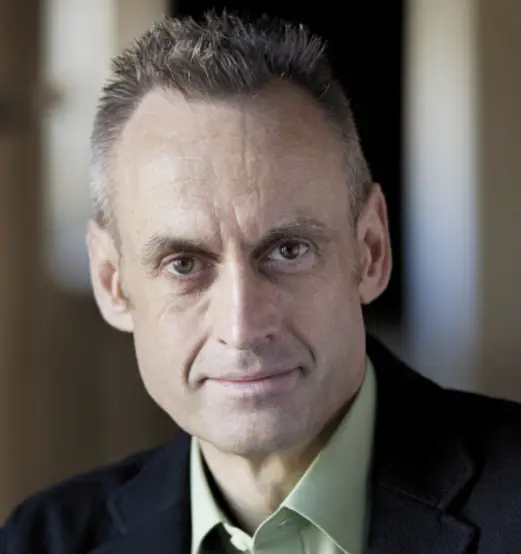
Paul Boos
Paul Boos, Salvador Dali in a ballet diary
photo personal archive
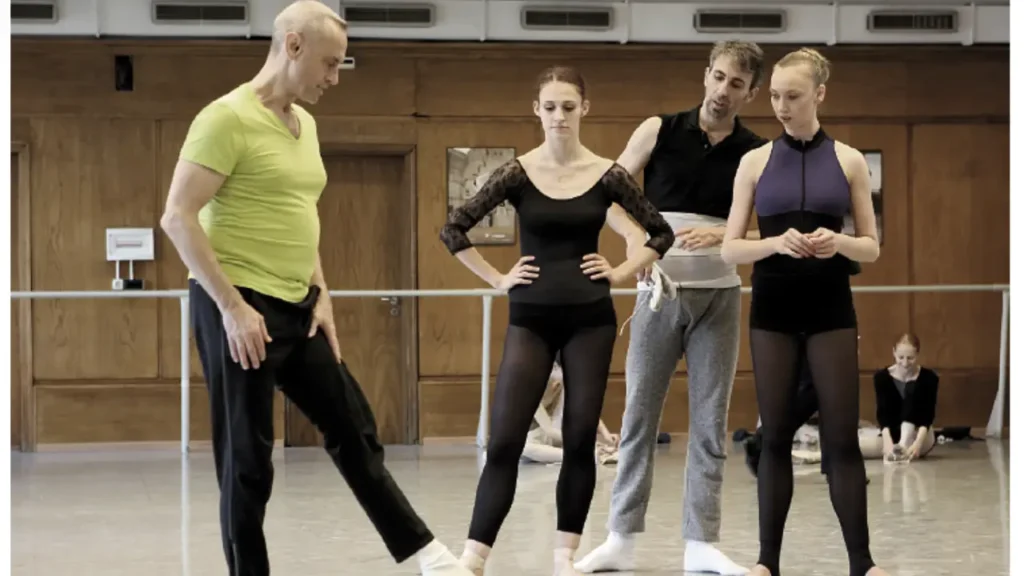
For Paul Boos, our interview is a chance to have breakfast and take a short breath in between of rehearsals for Apollo – ballet, choreographed by George Balanchine. Paul Boos is couching and preparing primas of Bulgarian ballet Marta Petkova and Katerina Petrova, as well as their performances with their colleagues from New York Ballet and Pacific Nordwest ballet. Conversation we have is so interesting and starts with such ease that Paul forget to drink the soda and eat the banana he have ordered.
Paul is a former soloist within the New York City Ballet and a current Balanchine Trust licensed repetiteur.
He was in Sofia for the forth edition of “American Ballet for Bulgaria” which presented the biggest stars from the troupe of the world-known ballet dancer and choreographer Tom Gold with the special participaton of Sofia Opera and Ballet primas Marta Petkova and Katerina Petrova.
Five ballets were performed for Bulgarian audience:
the George Balanchin’s ballet “Apolo” which costumes were initially created by Coco Chanel, and music by Igor Stravinsky.
“Gershwin Preludes” music by George Gershwin and choreography by Tom Gold,
“Concertino” by Igor Stravinsky, choreography by Jerome Robbins,
“Junk Duet”, music by Donald Knaack, choreography by Twyla Tharp (Twyla Tharp has worked together with names like Miloš Forman, David Byrne, Mikhail Baryshnikov),
and “La Plage” – ballet after choreography by Tom Gold and music by John Zorn – an avant-garde multi-instrumentalist, saxophonist, inducted into the Hall of Fame by Lou Reed.
Paul, you are working in the world’s largest opera houses, including New York, Petersburg, Paris, and Milan. How were you chosen as a repetiteur, and what is the Balanchine Trust?
The Balanchine Trust is the organization preserving and protecting the accurate execution of all of George Balanchine’s choreographies – 400 in all, 75 of which are performed across the world. The Trust’s mission is to conserve and execute them in the manner that Balanchine would have desired. Following my retirement from the New York Ballet in 1991, the Board members encouraged me to work for them.
I teach the choreography and assist the ballet dancers in realizing them which differ greatly from those taught in Europe’s traditional dance schools. I teach them executing the choreography in a way that is both brilliant and in line with Balanchine’s original goal.
How did your father, a sheriff, come up with your idea to be a ballet dancer?
He was a military man, first as a navy marshal and then as a sheriff, and he was tremendously tough and macho. He ran away from home at the age of 14 and he knew what was like to be young and have a dream.
I was 15. I attended a summer ballet school in New York. At the end of the summer, they offered me a scholarship monthly and to cover my all edication. It was a gift from fate. My parents realized I had a talent and let me move from South Dakota to New York. I had three years of intense, rigorous training and a highly serious education between the ages of 15 and 18. And I got the opportunity to study, to train under the greatest, and I eventually worked with George Balanchine and the New York City Ballet. Alongside West Side Story stage director Jerome Robbins as well.
What have you learned from them?
Both were very strict about technique. Balanchine taught us to live the music and express ourselves, he saw our potential, he helped us blossom and develop. Balanchine taught us the meaning of what we learn for our future. It helped us realize how unique we were. Jerry Robbins paid more attention to accuracy in completing tasks as he perceived them.
Which famous ballet dancers have you worked with?
With many great ballet dancers. Baryshnikov is one of them. With him, I realized that the bigger the star, the more modest and more human the person. Baryshnikov has developed to the point where he is aware of his abilities and feels at ease with himself. Baryshnikov has grown to the point where he feels comfortable with himself and realizes what he is capable of. Often, those who are insecure act like stars. They are difficult to work with.
Salvador Dali you have met was not a modest celebrity I suppose.
Yes, (laugh). I met him when I was 15. One of the girls from my ballet class, friend of mine was quite a bizzare, nasty girl. She dessed colorfully, like a clown. Turns out she studied at the Ringling Brothers Clooney Academy. She came from an extremely wealthy household. I grew up in South Dakota in a place that is painfully boring and I have always been drawn to unusual people and things. This girl offered to introduce me to Dali. I said yes, not believing her. I thought she was joking.
When I went to his hotel, the St. Regis in New York, up Fifth Avenue, right next to the Cartier store, Dali and his wife, Gala, were seated at a table across from each other. They had surrounded themselves by group of models, Dali – by women, Gala – by young men. They were surrounded by youth. I was 15, the youngest. But Dali paid attention to me. He talked to me, asked me about my life, my family, my brothers and sisters – simple questions. I taught to myself, “What makes him interested in me? Some kid from South Dakota’. He was so nice and friendly. Balanchine behaved the same way with people. He could be talking to a total stranger.
What happened next?
For some reason Dali liked our chat and he invited me to a party of his. He use to organise them at Trador Vic’s, a highly exclusive Polynesian-style restaurant in the Plaza Hotel. I was a student and I dressed badly. He said I should wear a suit and tie for this special restaurant. He offered to buy one for me so I could go but I lied that I had one and thank God I had a friend to borrow it from. For three years between 1973 and 1976, every time Dali came to New York, he called me and invited me to his parties. I have met many colorful and strange people. They served exotic drinks with gardenias floating in them. The flavour and scent of the drinks were outstanding.
Dali was very generous to me and finally invited me to his home in Barcelona. He wanted to pay for my trip, but I didn’t go.
Why?
I had never left the country, I didn’t speak Spanish. I was still a child. I had also heard stories about his personal life that horrified me. He was a pervert. I don’t know if I should tell. I will, and if you think so, publish it. I feel a little uncomfortable to talk about it. There was a rumour about a famous model that he had invited to stay with him and tried to persuade her to have sex. Every day she told him: ‘No!’ At the end of her stay he gave her a tiny glass bottle with a beautiful stopper, that appeared to be his design. There was liquid in the bottle.
The model said, “What a pretty bottle, but what’s in it?”
Sperm or urine? We are talking about Dali. After all!
Sperm. He explained: “Every time you rejected me, I masturbated.” Another story I learned from a friend of mine who was at the beach with her boyfriend (a friend of mine as well). Salvador Dali approached and offered to paint them. They were intrigued. They went to his house where huge crystal bowl the size of a bathtub was filled with scrambled eggs. Dali invited them to go naked into the bowl and make love. They refused and left. When he invited me, I was 17. I couldn’t face that.’
Maybe I regret it in a way because it could have been just a great trip, meeting inspiring people. On the other hand, my life has taken a different direction and I am very happy about it.
Dali and I talked about life. It was very interesting. And he, like Balanchine, spoke in abstract terms – about the beauty of life, about the past, about interesting scenes and incidents. They could see beyond.
Both were looking for depth. People thought Dali was clear to them, but there was always a deeper level to him. It was from him that I heard for the first time about Balanchine and about the people with whom life subsequently met me. And after a few years later they became my mentors.
It’s like he saw your future. The 70s were fantastic in New York.
Yes. It was the time of Studio 54 and Andy Warhol and we used to go there. Naturally, I was not one to arrive in a limousine. We had to stand outside. A boy, Mark, stood at the door. Everyone was calling his name and trying to get his attention to let them go. And he would make a hand gesture or look at you and say, “You! Come in.”
He usually chose me to enter, but sometimes he wouldn’t let me in. I never understood what exactly this depended on.
And inside?
It was all a fantasy. You enter amidst crazy lights, pulsating music that makes your heart beat faster. You feel arousal, total incontinence and a desire to relax.
Were there drugs?
Of course. Cocaine was everywhere, and so was LSD. Everyone was on the principle – if you see a pill, you take it. Not caring what it is exactly. Nobody cared about the consequences at the time.
But you survived?
I did, but not everyone made it. I’ve seen Liza Minnelli, Bianca Jagger, Mick Jagger there. Jackie Onassis was also coming. Rudolf Nureyev… Baryshnikov – very important people, very modern. People from the theater, music, dance, politicians… It was a very dangerous and strange place. There were people on the corners having crazy wild sex.
What do you remember about Lisa and the Jaggers?
They were dressed like kings and queens, and if you looked over their shoulder, you could see that they were inhaling white dust. Hahaha. I can’t pretend it didn’t happen. One of the owners, Ian Schrader, had a taste for ballerinas and always married beautiful ballerinas. The other was Steve Rubell. The two enforced the idea of exclusivity – making people wait outside so they want to get inside even more.
And when they walked in, everyone felt special. And at the thought of meeting Andy Warhol and all the stars. For me at that time it was already normal, because as part of the New York Ballet, I was already part of the crème de la crème and belonged to that society. At the same time, I remained the boy from South Dakota, going wild when he saw Bianca Jagger or Warhol or the big stars of Hollywood celebrating with everyone else. This club harkened back to Caligula, bacchanalia and orgies.
And what does the name Badona tell you?
Hahaha. In the 80’s I studied with Maggie Black – a very famous ballerina. Madonna was also in my class. She was at the beginning, she was a nobody like all of us. She had her hopes and dreams and efforts. Our teacher never managed to learn her name and instead of calling her Madonna, she called her Badonna.
She hadn’t heard her name and remembered it on wrong way. And Maggie was one of those great teachers you’d never allow yourself to correct. You just agree and Madonna never told her she wasn’t Badonna. Years later, when she became famous, a friend of mine asked me: “Don’t you remember this woman?” I asked: “How do I remember her?” And he reminded me: “But it’s Badonna!”
What are you doing to make your life interesting now?
My life is interesting. Looking back, I can appreciate those memories, but I am different from the people I told you about. I was just on their way, got on the roller coaster at the amusement park and had a chance to ride. Now I feel like the person who puts other people on the roller coaster of incredible experiences.
People like these beautiful ballerinas in Bulgaria – Katya Petrova, Venera, Marta Petkova – I lead them on this incredible adventure in the land of Apollo. The Eastern technique, which is fundamental here, follows very strict rules. American has the same roots, but we move more freely and almost in a jazzy way.
And my job is to show the movements the way the Western School does them. The ballerinas here are brilliant and they are capable of this work, but I help them understand the style. Between You will see what happened to ballet from the 20th to the 21st century. It is clear that we are moving forward.
Have you heard about the Ballet Competition in Varna?
Of course, the entire ballet world may not know where Bulgaria is, but they know about Varna. Every child wants to compete in Varna. When I was 15 I wanted too. It is probably the most important ballet competition in the world.
Several ballerinas and ballet dancers at the Paris Opera spoke to me about the possibility of coming to compete in Varna, because performing at the level of this stage gives you the opportunity to rise in your career – and this applies to Paris, Moscow, St. Petersburg, New York. Baryshnikov was a medalist here and grew out of this scene.
It’s a bit like the most famous horse races, where the most famous owners go and watch to get the horse they like. It is a turning point in the career of many artists. It’s funny that I knew it was in Eastern Europe, but I didn’t know it was in Bulgaria.
Follow @lili_ili_eva
Leo nulla cras augue eros, diam vivamus et lectus volutpat at facilisi tortor porta.