Tristan Ra
Tristan Ra Artist on the fragrance and colours of Paradise
photography: Peter Nastev
Carla Bayle is a village situated on a hill in southwestern France, on the ruins of an ancient Huguenot citadel. It is surrounded by a terrace offering wonderful views of the surrounding hills, fields, lake and the Pyrenees at their very heart. It is famous for its many galleries and exhibition halls, more in number than the locals, and for the plastic arts festival that has been held there for 20 years. On one of the festive Thursdays, when farmers from the surrounding area sell food and wine, street performers have glided through the town. Painters, sculptors, and ceramicists have all opened their galleries for free admission. This is how we come across Tristan Ra.
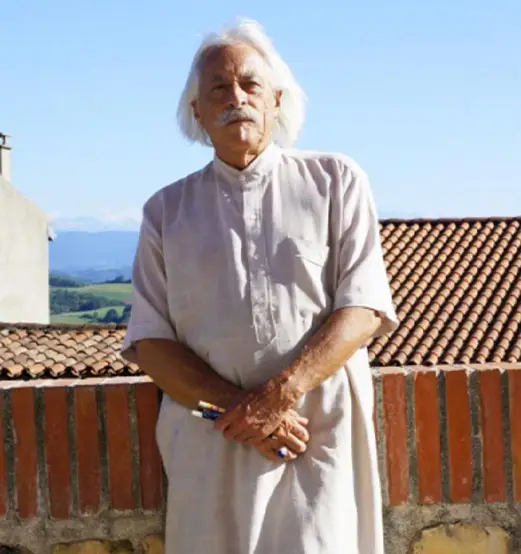
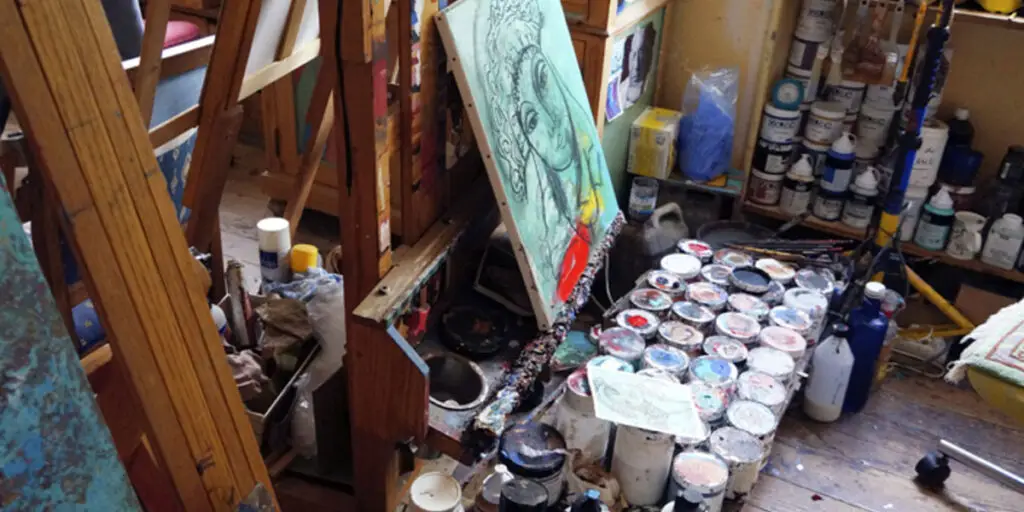
He looks like a character out of an Arabian fairy tale – wearing a long shirt and sweatpants, shoes and a musketeer’s chin. He sits outside his three-floor yellow house with blue shutters on the windows. His gallery and studio are inside too. He is the man who, with a group of artist friends, revitalized the village and together they organize exhibitions throughout the year. He travels a lot – to Africa, India, Libya, Jerusalem, Istanbul, Iran. His paintings are sold in galleries all over the world. And as happens more often with people who live in the South, our conversation flowed on its own.
‘Before I came here,’ he says, ‘I used to paint pictures on the pavement in Saint-Tropez, commercial, repetitive, standart – boats, the bell towers of the town of Collioure… If you work hard, you can make a lot of money out of it.
My wife and I were living well. And I was happy. I’m from Paris and I studied medicine because my parents thought it was prosperous, and I dreamed of studying at the Academy. I graduated. I started working as a pharmacist. I worked nights in a pharmacy, during the day I went to drawing lessons. I couldn’t sleep from stress. And here’s your solution – I started smoking weed to reduce stress. In those years – I’m talking about the ’60s, everybody was doing it and in the same time it was no well received. One of the neighbours complained and I was put in jail.
For smoking weed?
The conviction was for drug use and inciting others to smoke. I was in my twenties and… we’d get together with friends, invite girls over, drink wine, talk, we suggested them to try. Okay, few of them up started to like it. I was sentenced to five years. Can you imagine?! I was released after one. And when I got out on May 5, 1979, I decided to change my life, to start drawing, even if it meant starving to death. I didn’t want to do anything else. I enrolled at the School of Art and Design in Toulon, but I wasn’t interested in that academicism. In the second month, one of the teachers, Lopez Palacios, said to me, “If you want, come to my studio. You can work with me and I can teach you. I’ll also give you the keys of my studio to come and paint on your own whenever you want.” I quit school. I made a lot of progress with it. And then I worked in Saint Tropez for 15 years. Finally, my wife and I saved money for a house.
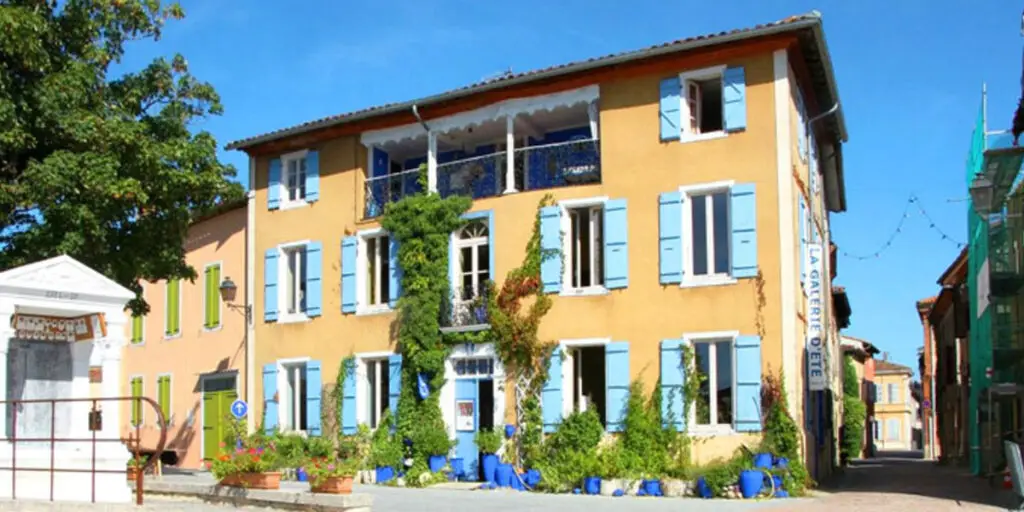
Къщата на Тристан Ра
You mean you saved money for a house from the paintings you sold on the street?
Yes, but I worked a lot. I painted and sold every day, every day. Having a house and land in the French southeast was always very expensive. The price was ten times higher than here. With the savings of 15 years, we managed to get a little house – 35 square meters with about a hectare of land and a wonderful view to Saint Tropez, without electricity and water. And we had two young daughters. It was very difficult. Really misery. And then I remembered I had a friend in the Southwest. I came to see him. He and I came across a very beautiful renovated building of 200 square meters with hot water, gas and 40 hectares of land for the price of a little house of 35 square meters – 120,000 euros. In the same week we sold the small house near St Tropez and bought the big one near Carla Bayle. At the same time, for 7 years, a very elegant gentleman with a strong Russian accent bought small paintings from me. We sat down sometimes to have a glass of wine, talked about art history. He turned out to be a great art dealer. He worked with galleries all over the world. He was always watching to see if I would change my style. All of a sudden he offered me a contract for 10 years to do 150 works a year. I signed the contract without reading. And those numbers meant I was starting one painting every day, and for a very long period of time. But I stopped working on the street.
And how can one have inspiration every day?
You don’t have to ask that question at all. In the first years I was very late. And he wasn’t happy because he was doing an exhibition program. He showed the paintings everywhere – in Zurich, Brussels, the Netherlands, New York, Miami, Singapore. He was an extraordinary man and dealer – André Vladimir Deper Lavi. He spoke 10 languages. After a while I caught up and drew more than included in the contract. At the end he offered me a new one, but I refused. It’s very hard, very stressful – to work and be at your max, to think about it every day, for 10 years.
Is it true that your gallery was the first one here?
Yes. The village was destroyed and deserted, like after a war. There were many houses without roofs. The square was not paved. Elderly people sat in front of the town hall dressed in black. And it was without a roof. The houses cost two thousand euros, there were even houses for 200. I bought a lot and resold them to friends. The one where my studio is and where we are talking now was deserted, not opened for 50 years, had no price. And it was a lovely house, in very good condition. I thought, “Why don’t I open a gallery here?” And I did. People came to laugh at me. But I had a contract that brought me a lot, and I didn’t care if I sold in the gallery. I was laughing with them. If I was starving, it wouldn’t be like that. In time, even though there was no culture in the Ariege area, people started coming, even buying.
In 1985, Carla was a village from the deep countryside. To see a painting for sale for 5 grand… the locals were very surprised. Things were sold for pennies here. We weren’t even part of the commune. There was a change when the Minister of Foreign Affairs, Laurent Fabius, came to live here. He is a great collector of fine art. And he started coming to my gallery often. On top of that, he took to staying. The municipality started to help us.
Is that how a run-down village became an art centre?
Gradually I brought in artist friends who were running galleries and didn’t need to make money selling here. In the beginning there were a lot of uninhabited houses. We did exhibitions on their doors, on the street. We did a few experiments like that and it shocked and attracted people. Then we moved the headquarters of the association Rue des arts (Street of Arts) here. Many artists wanted to come. And little by little… People started coming from Toulouse too. We were having big dinners in the square and it was getting very cosy. It took 30 years for the village to develop and become what it is now.
You have a very interesting pearl necklace. Where did you get it?
From Polynesia. Next to where we lived for a year, they grew pearls in oysters. A lot of oysters were escaping from the nursery and when you dive two meters underwater, you find them. I used to collect them one by one.
When did you live there?
In 2000, a gallery I was working with offered, “If you want, we’ll pay you to go anywhere you want for a year and paint. We buy 80 paintings in the place you choose.” And I suggested to them that I go first to Polynesia, then to the Marquesas Islands. I’ve always dreamed of those lands because of the transformation in Gauguin’s work when he gets there. I really like his paintings and wanted to see what changed his painting from classical with great precision in detail into cloisonné (a style in post-impressionism). He lived in a time of classical, flat, predictable and overly polished art. And in Polynesia his painting exploded, went mad. His colours become so vivid – violet, red, moreover he starts to separate the human body. It stirs the history of contemporary art. He must have received a huge inner shock to be able to change completely and start expressing himself totally differently.
And what did you find?
Islands that look like a snake of black rocks rising from the sea. Very raw. There is no beach. I travelled there for 10 days by boat. It’s really far and it was very expensive. There was only one hotel on the 7 islands. You have to live with the locals. Getting around is tricky, it is possible with a 4×4 car. It is no easy to draw paintings. I did portraits of the people I stayed with. The locals are good, but you can feel the wildness inside of them too. Maybe Gauguin chose them because he wanted to discover exactly the wild side of man.
And where is the key of change in Gauguin?
I don’t know, it’s not just the place. In Polynesia, especially in the Marquesas Islands, there is a particular fragrance… the fragrance of paradise.
А! What is the fragrance of paradise? Maybe there are a lot of Eves and apples?
Hahaha. Yes, there are real Eves. Gauguin had a twelve-year-old mistress there, which is normal in Polynesia. Girls mature at 12 maybe because of the sun, the heat… That’s when they’re at their best. Their beauty lasts until they’re 16. Then they get very fat.
And I found the key one day when I was cycling home after a rain. It smelled so strongly of ylang-ylang that it was as if everything had been rotten by the scent. You get a shock from the strength of that smell. My senses are heightened by powerful scents. In Polynesia and on the islands it smells like coconut and ylang-ylang. I think Gauguin got something of a shock from that. The scenery is beautiful, terrifyingly beautiful, but without being some kind of miracle. The key isn’t the colours per se. There is something else that makes everything divine.
Are there any other famous people among your clients besides the minister?
He has helped us, but he has never bought anything. There are many industrialists among my clients. At the moment I have a client in Toulouse with a consulting firm. His offices are wonderful. He commissioned me to paint the portraits of all the bosses there. He hangs them on their doors. I painted 14. He loves fine art, is rich and buys a lot.
Do you have any painting rituals? Drinking wine, for example.
No. There are artists in art history who drank wine to paint, but that’s not how it works. I observe reality during the day and late at night I let it come out on the canvas.
And where does your name come from?
I’ve tried different pseudonyms. My little name is Gerard Tristan. And my mother used to call me Ra when I was little instead of Gerard. It came to me when I was signing the contract with the Russian trader. And he liked it.
Follow @lili_ili_eva
Leo nulla cras augue eros, diam vivamus et lectus volutpat at facilisi tortor porta.