Tunisia
Tunisia, the black heart of the desert
2021
photo: Lilia IliEva
The real face-to face with Tunisia is at three thirty in the morning, in the desert, before sunrise. When you open the window of your hotel room and the cool comfort of the air conditioner running all night radiates the heat from outside. After a few hours it becomes relentless, like a furnace from which there was no escape. Then you realise how much strength it takes to keep life alive here and to march insistently from the dead sand dunes to the fabulous oases and modern hotels.
Travelling to Tunisia is an adventure among the scenery of Star Wars, Indiana Jones and Gladiator, walking among the ruins of Ancient Rome, Carthage, tasting good local wine, visiting Berbers still living in their cliff dwellings.
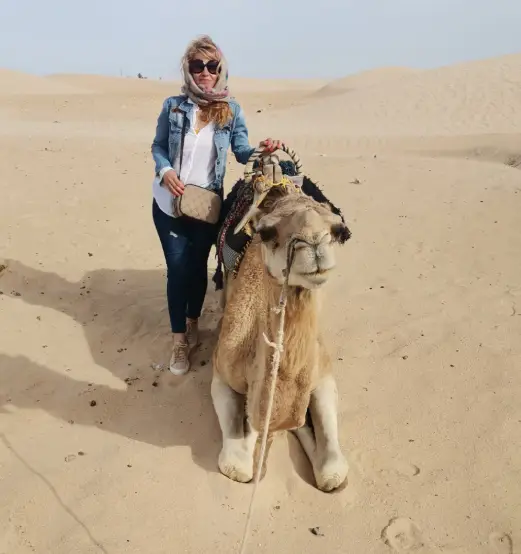
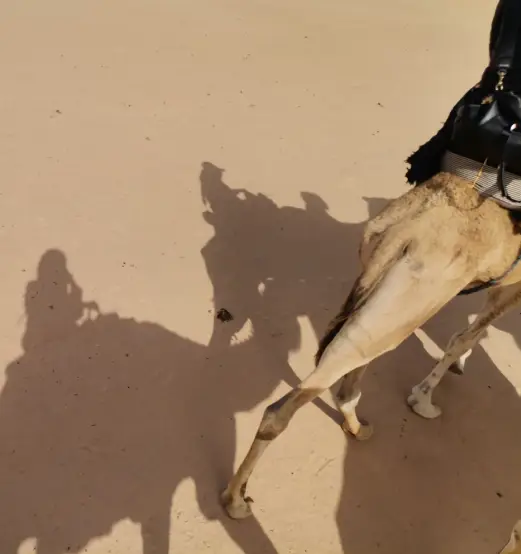
It’s ATV fun in the desert, riding on high camels that sway slightly and seem to watch where they step so as not to hurt you. Tunisia is a luxury experience in fabulous hotels on the Mediterranean coast with pampering in thalassotherapy centres. It’s also confronting poverty in landscapes along the way that resemble a cross between a dump and a construction site. In the picture of memories that Tunisia leaves, there are of all colours. And it is truly worth experiencing.
As the plane approaches Hammamet, one of Tunisia’s northernmost resorts, a Roman colony centuries ago, the rectangular white stone buildings are the first to stand out. Whether because of their blinding white, or because the sun is brighter, but the light here is unique, different, softer, more translucent. It’s like your eyes widen and you can see more. And your gaze is lost in the incredible wide of the flat land without hills. Our guide Dmitry is a young handsome Ukrainian, like he stepped off a fashion magazine photo shoot. He warns that it is advisable for foreigners to travel in Tunisia only by bus and guide. Walks of up to a kilometre or so around the hotel are permitted. At the entrance to the four-star Novostar Khayam Garden Beach, where we first stay, we are greeted by a flash mob of cheerful animators. They’re quite contactable. They pop up out of the blue while you’re having coffee in the morning sleepily by the pool or when you leave the room. They attack the birthday tourists with cake and songs in the restaurant, photos and instant social media posts.
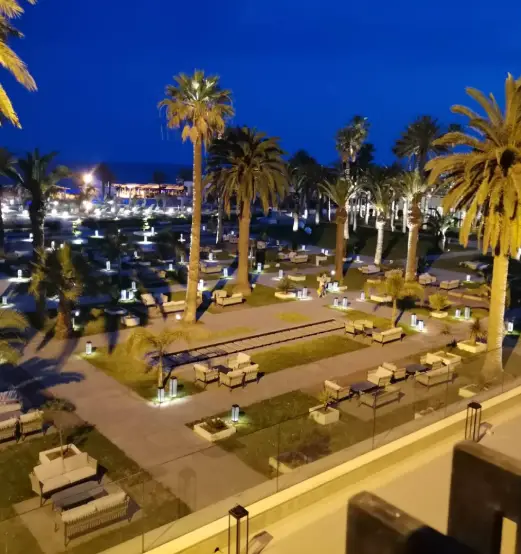
The view from the window of every room is like a postcard – palm trees, a beach with fine sand, the aquamarine blue of the Mediterranean Sea, and with every hotel it gets more and more beautiful. The plates of fruit – a compliment to the guests – get more and more plentiful. Among them there are some very tasty muskmelons that look like small peaches, and dates that have gathered all the strength and sweetness of the bright sun. They are so delicious! You eat them and, as the Russians say – five minutes in the mouth, an hour in the belly and a lifetime on the ass.
food in Tunisia
The thought of the scales must remain in Europe. The only “clever” move for the trip to Tunisia is wider clothes to save stress in front of the mirror. Here is the paradise of fresh just-caught fish, seafood and aromatic spices such as chilli, saffron, cumin, coriander, turmeric. There’s divine hummus, for lovers of spicy – the local harissa pepper sauce is wonderful. The country ranks third in pasta consumption after Italy and Venezuela, so it is also a paradise for all spaghetti and pasta lovers. They top them generously with tomato sauce (with more or less spices) and, lamb, beef, fish, rabbit, chicken – according to the wishes and the region. The tajines with pilaf, or with cooked vegetables and casserole-like meat, are fabulous. Joyfully or not, our program includes a culinary course.
Prepare the brisket. It looks like a calzone of round and thin as for a pie crust of semolina, filled with potato salad with onion, egg, tuna and optionally – capers, olives, parsley, hard yellow cheese and whatever you can think of. It is important that the egg inside remains crumbly. We fry the brioche under the guidance of a cheerful chef, eat, and then even dance. Those who don’t have the strength lie down in a hammock. And it’s a good thing he’s got them together, because lunch is next. On a beautiful local woven carpet, the table is loaded with mini pizzas and giant prawns, crispy squid, octopus, salads with spinach, tomatoes, kyopoolu, meshua (which is like kyopoolu but with chilli peppers), couscous, salmon bites, delicious breads (the local tabuna is made mainly with wheat semolina and no flour) instead of a tablecloth. Next comes the main course (fresh fish) and desserts. Often the dessert is watermelon, but there are also oriental options like baklava with almonds, dried fruit, pine nuts and pistachios. A must-try are the horns of the desert – pastry with lots of different nuts and caramel. For those feeling nostalgic for our latitudes, there are bambalons – mecakes rolled in crystal sugar. The tea is a mixture of green and mint, served very sweetened in a cup in which float peeled fresh almonds. One is enough for a main course, then one might as well not eat at all. Even if you only drink tea in Tunisia, you still can’t diet.
medinas
are in all cities – small neighborhood with preserved medieval architecture. Their buildings are the white ones I saw from the plane. Rectangular, with blue doors and windows in the colors of the sea, because most of the locals are fishermen. The streets are narrow, so they are always in the shade and there is a draft. Fish and Fatima’s hand are painted on the walls against evil eyes. On the wooden gates there are copper hammers. Once men knocked on the right and women on the left, and so the woman inside the house would know what kind of man was coming. In the medinas there is usually a market of all kinds of handicraft goods – you can buy the famous beautiful pottery, locally woven carpets, mosaics, babouche slippers – leather islands for men and embroidered with silk or cotton, with gold and silver threads with floral motifs – for women. There are also spices, dates, leather goods. The marketplace is a must. There is expected to be some haggling before you buy anything.
thalassotherapy
Tunisia ranks third after France and Spain in the number of thalassotherapy centres. Its advantage are the more affordable prices. These oases of seawater-related pleasures are necessarily located at least 4 km from a port and half a kilometer from a city. The water is drawn 450 metres from the shore and from a depth of 6 metres. We have the pleasure of enjoying thalasso treatments at the five star Hasdrubal Thalassa & Spa Yasmine Hammamet. It’s like the décor of a Scheherazade fairytale – with Arabic mosaics, crystal chandeliers, marble bathrooms, plush furniture, huge corridors, lobbies and rooms. There are four restaurants, two of which feature original Tunisian and authentic Italian cuisine. It is located on the waterfront with sea views. Its courtyard pools are surrounded by palm trees, jasmine and cactuses.
There we witness a lavish Arabic birthday party with Tropicana-style dancers and stilt dancers that goes on until two in the morning and begins to bring us back to the feeling that life is alive. (Which is inspiring after the surreal deadpool that reigned during the lockdowns for COVID19. My trip to Tunisia was on the second charter flight after they released the option to fly.) And the thalassotherapy center is another dimension where the only possible state in pleasure. There are therapies to improve circulation, anti-cellulite treatments, to lose weight (rather doubtful with this delicious food), eliminate joint and back pain, increase vital energy. There is a sauna, a hammam, a pool with cool sea water.
Boris Yeltsin
Before poking the lion Boris Yeltsin in the ribs with a stick through the bars of the cage, the black-eyed Berber who is guiding us the zoo excuses him by saying, “It’s hot! Sleep!” (i.e. – “It’s hot! Sleep!”). And then shouts to him. “Tourists!”
The Berberine is no taller than six feet, blue-eyed, dry and thin, with big sweatpants and a big smile. His name was Fedya. I suspect he’s making it up, since he can hear us speaking in Bulgarian. Fedya shows us Claudia Schiffer the monkey without makeup. Then he drops a cigarette box, out of which a scorpion with a writhing stinger crawls and hoots. After the sting there was a guarantee of up to 15 minutes of life. After some chasing, Fedia puts it back in the cigarette box. He disappears into a little house in the middle of the not very big zoo Le Paradis (The Paradise), to emerge with hugging salamanders and show us what love is. Then he comes running, holding the tail of a boar, which puffs up menacingly, and finally brings us a poisonous snake on a stick, which he throws artistically onto the sand between us, and it starts moving rapidly sideways.
Sahara
The zoo is on the edge of the desert, in the city of Douz, in one of the largest oases in Tunisia. Every year there is a festival in Douz. It brings together nomadic tribes from Kuwait, Libya, Algeria, Egypt and Jordan. There is a camel race, exhibitions dedicated to the local way of life, local culture and traditions. There is also the Sahara Museum. After Douz, the landscape on both sides of the road deserts and we enter more and more into the vast sandy ocean. It is majestic. The Sahara covers 40% of the country. It is flat in some places, with small dunes in others and sand hills in others. Its sand is fine and soft as silk. Part of the ride is by off-road jeeps that climb and descend steep inclines or drive sideways. At one of the places we stop, a bar in the middle of the sands, they point out a mirage in the distance – the first I’ve ever seen in my life. It turns out to be a maroon, similar to the one that sometimes forms over the tarmac on a hot day here at home.
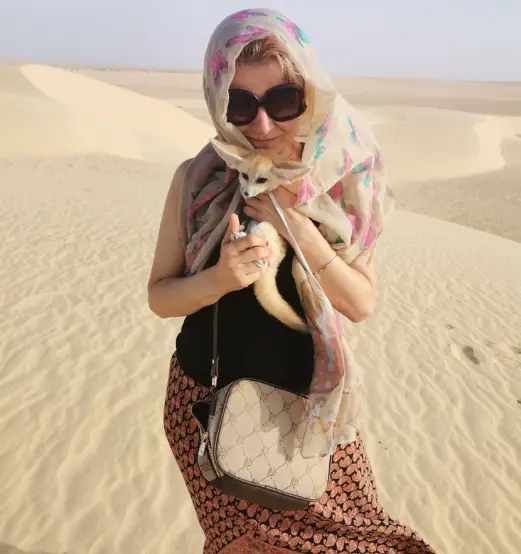
Since it is quite far away, it reminds of both land and water at the same time. Arabs push desert fennec foxes with ears like Yoda’s in Star Wars into our hands and bargain to take our picture. One of the Star Wars sets sticks ghostly out into nowhere with its sand houses, and in front of it stalls sell sand roses, bottles of Sahara sand and animal skulls and bones to tourists. Strange! I mean the bones. But it’s an adventure.
Her breath at night
Waking up in the desert, even in a hotel, is a special experience. It’s very quiet, even though the air conditioning is running. You go out and somehow it feels alive. You feel her warm breath, the heat in her veins, the ferocity of her temper. You feel how she numbs people to the limits of their strength, how she gives them sun and deprives them of almost everything else, how she laughs like a black witch as she watches the dance between death and life. And so every day.
Watching sunrise over the salt lake. It’s far away, I’m still not sure if I liked it. It was more fun to hover the ATV over the sand, looping in the hills, riding a camel, contemplating its long eyelashes as it swayed beneath me, and feeling the sun gradually piss down. And then to find that my face is all sand, fine as salt.
time machine
Travelling in Tunisia is like walking through different centuries and civilizations at the same time. Impressive is the Cathedral Mosque in Kairouan, the third largest in the world, built in 670 with its 35-metre minaret and ancient columns built into its base. It was originally a fortress and military camp. Its walls are 1.90 m thick. The square in its courtyard reminds me of the squares in front of Catholic monasteries and churches. In its centre is a well where Muslims wash their face, hands and feet before praying. Birds swoop and fly low over it. The muezzin’s voice during prayer is amplified by the wind. And those praying sit on their knees on dozens of hand-woven carpets laid under round crystal chandeliers. The mosque’s library contains books dating back at least ten centuries.
Part of going back is visiting the Berbers of Matmata, who continue to live in their hill-dug dwellings from centuries past. Our hosts tell us about Leo Bianchi from “Bulgarian TV” who came to film them. Next we explore the magnificent amphitheatre at El Jem, the largest in North Africa. The movie “Gladiator” was filmed here, we walk in the dungeons where the wild animal cages and the gladiators were.
Most elegant is the last hotel we stay at before we leave – The Orangers Garden Bungalows & Resort. With an ultra-modern design, paintings and statues by contemporary artists, a gallery and a modern art shop. It’s furnished extremely luxuriously. The rooms are from 40 sqm upwards. There is a magnificent garden with palm trees and swimming pools. The hotel faces the beach in the shape of the letter “P” with sand as fine as table salt. And after experiencing the magnificent food, the spa services, the real relaxation on the beach, where you are served fruit, water, juices and alcohol and where the umbrellas, sunbeds and towels are free, the plane back is coming. And the new encounter with reality.
Travelling to Tunisia with Emerald Travel’s direct flights from Sofia and Varna to Hammamet is interesting, peaceful, wonderfully organized and safe. More: at www.emerald.bg
Follow @lili_ili_eva
Leo nulla cras augue eros, diam vivamus et lectus volutpat at facilisi tortor porta.